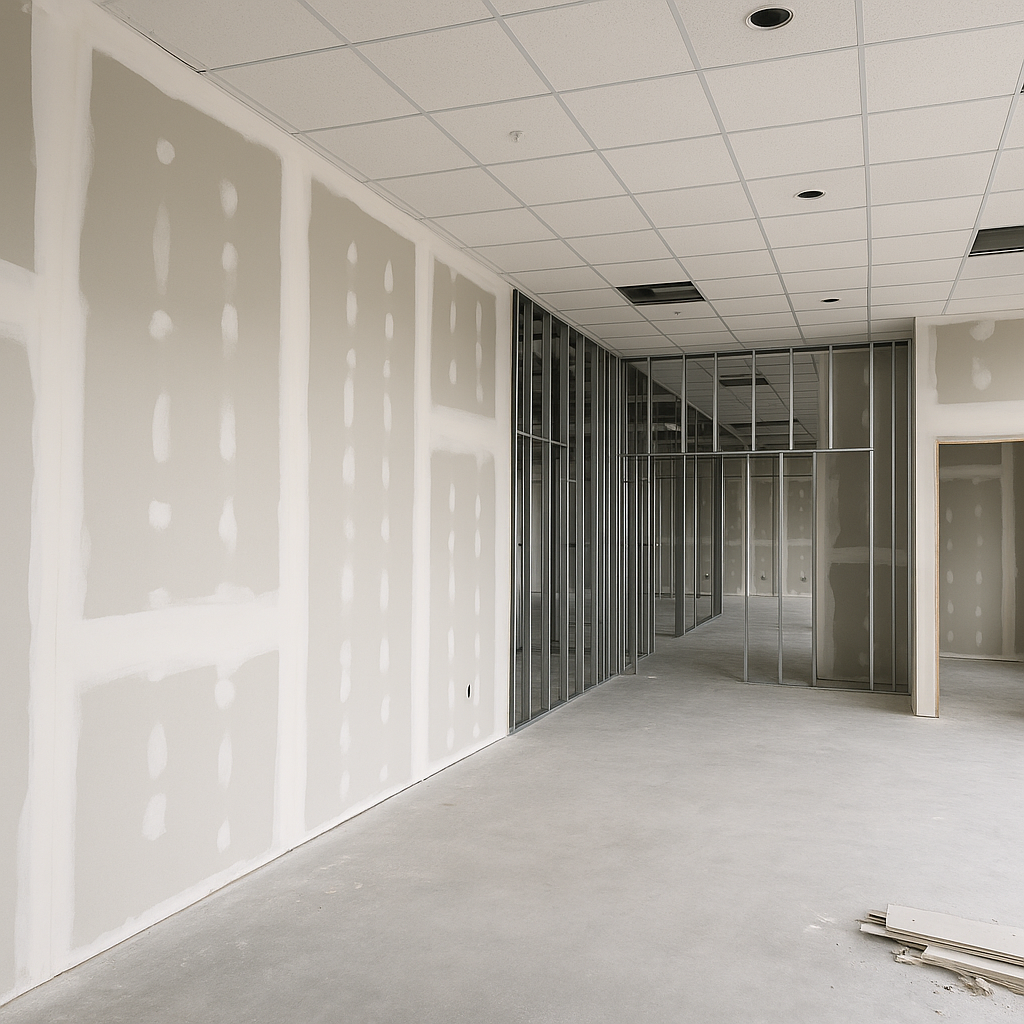
In fast-paced commercial construction, wall height changes can quietly drive major cost implications, especially in drywall-heavy builds. As projects evolve from conceptual to construction-ready, seemingly minor increases in wall height—often driven by design adjustments or system coordination needs—can escalate material quantities, labor demand, and even scaffolding or lift access requirements. For architects, engineers, and general contractors, visualizing the true cost impact of these changes is critical to keeping estimates grounded in reality.
Wall height is not a static detail—it's a multiplier. A one-foot increase across hundreds of linear feet of wall surface can result in thousands of additional square feet of drywall. That increase affects more than just board count:
In the rush of design development, coordination between disciplines often drives incremental wall height increases. MEP trades may need more plenum space, ceilings may shift, or mechanical runs might require soffits. If these updates are made without thorough communication, original drywall quantities—and associated labor—are left undercounted.
This is where proactive visualization becomes a financial safeguard. Estimators and design teams must employ tools that highlight how vertical increases influence cost layers early in the process. This requires visibility, not just intuition.
Incorporating visual feedback into estimating workflows reveals discrepancies that spreadsheets alone cannot. Rendering elevation views or color-coded model overlays gives teams the ability to:
When used correctly, visual analytics do more than communicate design—they illustrate risk.
The smartest estimating workflows now treat wall height as a variable that deserves tracking throughout the design-to-build lifecycle. A solution like Active Estimating enables construction professionals to model wall types dynamically and compare versions side-by-side. Instead of relying on static PDF markups, teams can tie wall quantities to model data and historical benchmarks.
More importantly, changes in height can be flagged and quantified, with predictive metrics showing how those adjustments ripple through labor, staging logistics, and procurement schedules. For estimators, this means the ability to course-correct before budgets blow up.
One of the most underutilized advantages in drywall estimating is production history. Capturing and referencing previous performance by wall height category allows estimators to calibrate future assumptions accurately. For example:
By applying drywall estimating tools that map historical performance to current scope, estimators gain not just visibility—but predictability.
Wall height changes are inevitable in complex projects. But their impact shouldn’t be invisible until construction. By leveraging data-driven intelligence, visual model comparisons, and integrated cost feedback loops, architects, engineers, and general contractors can get ahead of these cost drivers and protect project margins.
The future of drywall estimating is not just about measuring more quickly—it’s about visualizing risk in real time and eliminating blind spots with every iteration. That’s the standard we’re building toward, and the standard that modern construction demands.
Contact Information:
Active Estimating
508 2nd Street, Suite 208
Davis
California
95616
Rich Schoener
richard@activeestimating.com
(877)
Schedule a personalized demo to see how Active Estimating can work for your specific needs.

