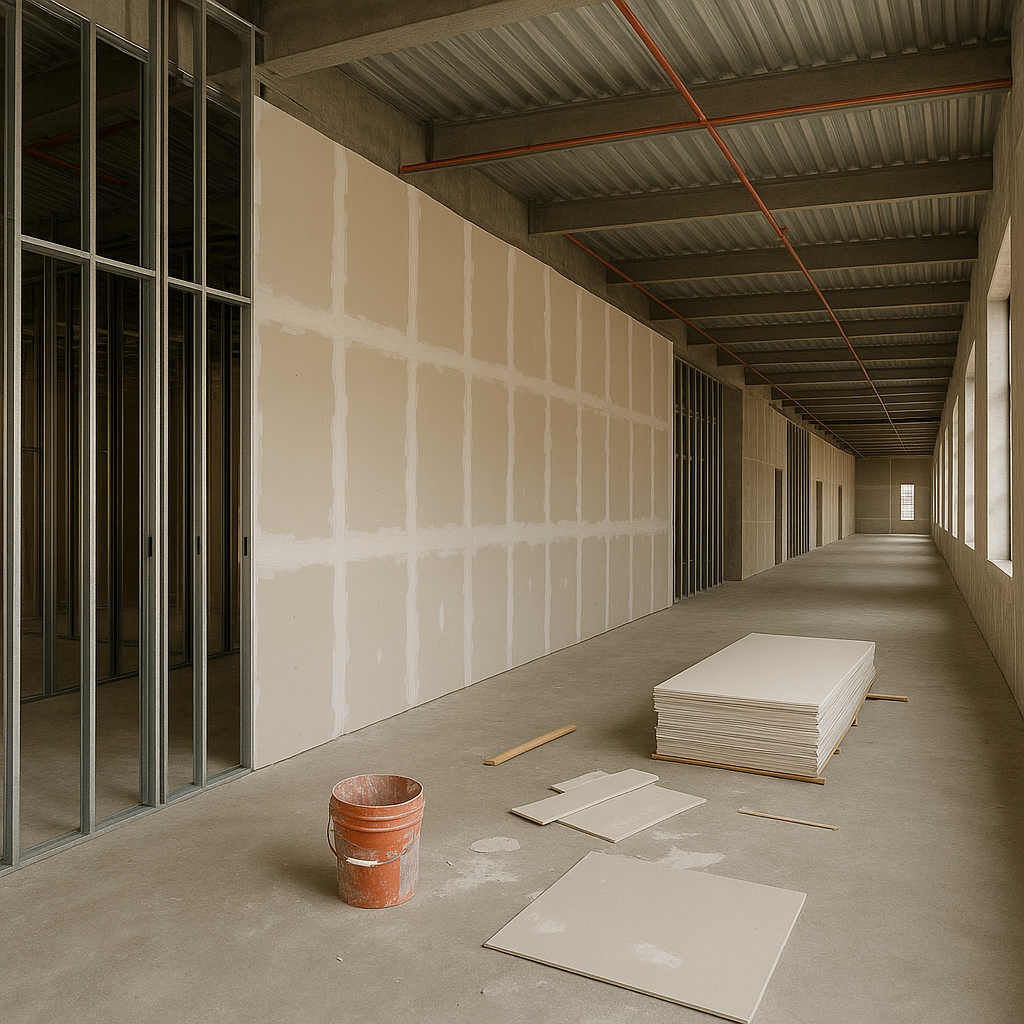
Firestopping is a critical aspect of any commercial wall system, but it’s often underestimated in its impact on both labor and cost. When overlooked during early estimation phases, fire stops can significantly delay wall progress, requiring costly remobilization and schedule changes. For architects, engineers, and general contractors, understanding how to account for fire stop installation in drywall timelines is essential for avoiding mid-project surprises.
Unlike standard drywall assemblies, fire-rated partitions demand specialized treatment to meet building code requirements. Fire stops are required at floor penetrations, wall joints, and around MEP systems. They disrupt workflow for several reasons:
Underestimating labor for fire stops can undercut bid accuracy. To avoid this, estimators should:
Estimators can also benefit from reviewing code minimums early in the project lifecycle to reduce surprises that require backtracking.
Data-driven planning enables teams to forecast fire stop impact on wall progress more accurately. Active Estimating supports this by maintaining a clear separation between standard and rated assemblies in the cost structure, allowing for unique labor forecasting and procurement triggers based on system type and timeline.
Through drywall estimating software that integrates continuous estimate feedback and tracks both objective takeoff data and subjective labor adjustments, estimators can align cost forecasts with actual field performance. This loop ensures that fire stop complexity is not buried in generic unit pricing but is tracked, adjusted, and reported in a way that supports project certainty.
Fire stops are far more than a checklist item—they are a labor driver that directly impacts drywall schedules. To avoid surprise delays and budget strain, fire stop installation must be anticipated, quantified, and modeled from the earliest phases of estimating. With integrated tools like Active Estimating, estimators are empowered to build more responsive and accurate plans that align with both safety codes and jobsite productivity.
Contact Information:
Active Estimating
508 2nd Street, Suite 208
Davis
California
95616
Rich Schoener
richard@activeestimating.com
(877)
Schedule a personalized demo to see how Active Estimating can work for your specific needs.

