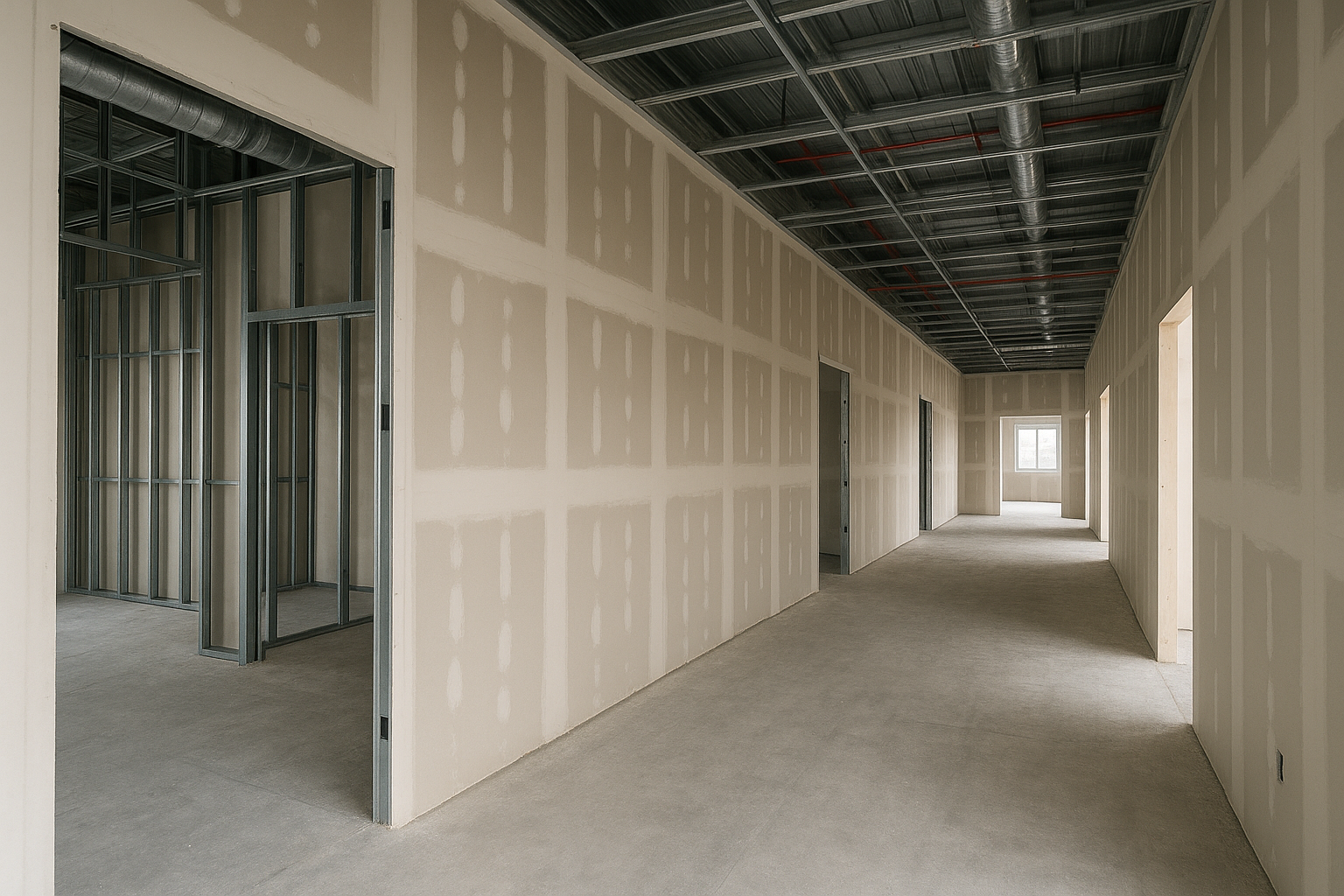
Estimating drywall costs for a core and shell project compared to a full fit-out involves fundamentally different assumptions, data sources, and risk considerations. For architects, engineers, and general contractors, distinguishing between these project scopes is critical to avoid misaligned budgets and scheduling setbacks.
At a high level, “core and shell” projects focus on the essential structure and exterior envelope of a building—columns, beams, floors, exterior walls, and sometimes vertical shafts. In contrast, a “full fit-out” includes everything from interior drywall partitions to ceilings, finishes, and MEP coordination. Each scope comes with different estimating inputs and cost behavior.
Estimators working on core and shell must often work with early-stage documents. The main challenge lies in forecasting assembly quantities without complete architectural details. This is where historical benchmarking and production-based analytics are valuable.
Full fit-out projects involve a high degree of variance in room types, specialty finishes, and MEP impacts. For example, estimating for a hospital fit-out may involve hundreds of unique room types with varying drywall requirements and coordination zones.
For general contractors issuing bid packages, scope creep and overlapping assumptions between core/shell and fit-out packages are common sources of confusion. Clarifying responsibility for drywall blocking, backing, or partial height partitions in early bid documents saves significant downstream coordination effort.
When real-world drywall production rates are captured and indexed by wall type, building area, and project phase, estimators can refine their models and reduce risk premiums. This is where Active Estimating provides strategic advantage—by enabling the integration of subjective adjustments (like crew size or material lift restrictions) into continuous cost projections.
Estimating for core and shell versus full fit-out isn't just about quantity—it’s about understanding the implications of design maturity, coordination complexity, and the data available at each phase. Treating them as interchangeable leads to misaligned expectations and budget gaps. Instead, establish distinct estimating strategies early, use data-driven intelligence, and adopt platforms that evolve with the project. The result? Fewer surprises, better alignment, and greater confidence from design through delivery.
Contact Information:
Active Estimating
508 2nd Street, Suite 208
Davis
California
95616
Rich Schoener
richard@activeestimating.com
(877)
Schedule a personalized demo to see how Active Estimating can work for your specific needs.

